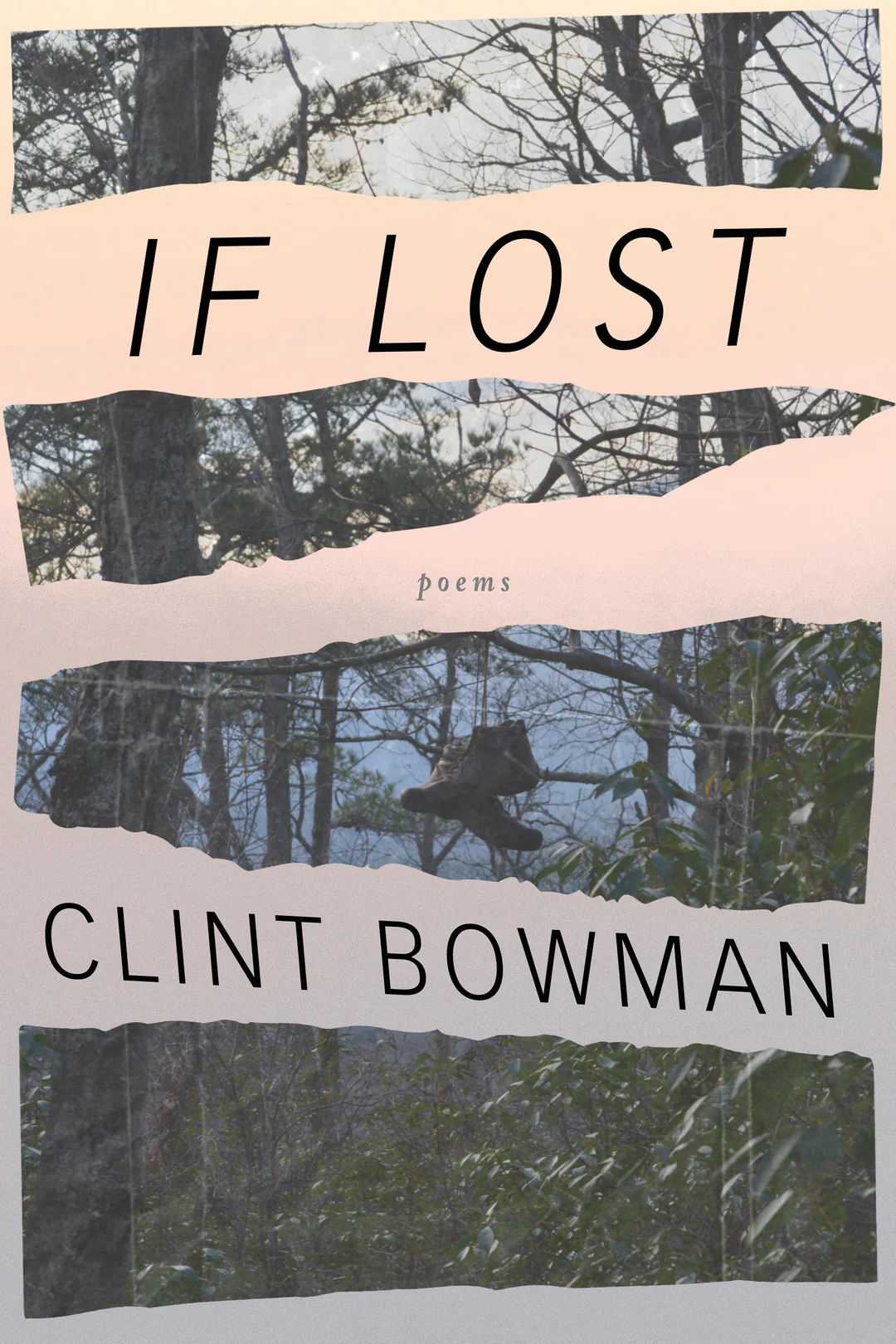
In early 2025 I had the privilege of hearing Clint Bowman read from his new book of poems, If Lost, at Poetry Hickory, a monthly poetry reading with featured poet followed by an open mic. Bowman explained he organized his book as a sort of guide for someone lost, with three sections that act as steps for what to do: Establish Your Bearings, Notice Nature, and Don’t Be Afraid. The poems in each of the three steps beautifully communicate how much we orient ourselves according to the features of our lives, such as home, family, and religion, but also how disoriented we become when something’s wrong in one or more of them. Through Bowman’s poems we witness how nature and place are deeply intertwined with each of the features, and when we do the work of re-orienting ourselves to the language of nature we can connect and build community.
When we’re lost, we’re presented with the choice to change our circumstances or stay where we are. When we refuse to change, we become the ghost of a place, trapped in our unfinished tasks. In the book’s first poem, “Ghost Town,” the speaker describes how he’s “somewhere in between/…contentment and complacency,” not yet a ghost (though “there are plenty/of ghosts to haunt you”), but perhaps on his way to becoming one (3). That’s the danger here: will the speaker become only a ghost, maybe even a living one, living out his life where his sister “looked just like me/when I began to feel/stuck in this place” (10)?
Bowman’s speaker is constantly oriented here in this place of choice, exploring being in between, somewhere on the edge of things, which plays out particularly poignantly in the poems about gas stations, the gas station clerk, and truckers who come through always on the move—always changing place—yet they always stay the same, as if ghosts, the truckers metaphors for how we are transient within our stationary existence.

The first section contains moments of disorientation, darkness, loss, aging, ghosts. It contains the moments or events leading up to disorientation, when maybe you haven’t yet fully recognized you’re lost. Part of being lost is recognizing you’re lost. Sometimes we’re lost long before we realize we are; it creeps up gradually, you’re walking along daydreaming when suddenly you look around and recognize nothing, there’s no path, no familiar trees or ridges. No landmarks to guide back. You’re not convinced at first. But the quickening of your heart tells you all you need to know.
Of course we can get lost, or lose ourselves, in many ways. Something happens that’s so disorienting we question who we are, who our friends are, our family, our religion. Maybe even place betrays us, leaves us for dead or so nonchalantly destroys that which we fully trusted in. Many themes like this appear in If Lost. And, as Bowman, a resident of WNC, pointed out during his reading, more than one poem presciently points to the issues surrounding Hurricane Helene’s destruction in Western NC, how deeply disorienting that event was for us in the area (If Lost came out the same year, but before September 27th, 2024). In “Act Natural,” located in the second section of the book Notice Nature, the speaker says we demand the world “smile for the picture” even when our “ecosystem is bleeding/at the gums/from this floss we’ve strung” (42). In “Detox,” also in Notice Nature, the speaker paints a picture of our rivers drinking “our intoxicated waste” where “In the runoff,/rainbow slicks/mix with plastic bags” (43). Our “sick planet” is “always hungover” where it’s “throwing up hurricanes/…desperate to detox/the waste that’s within.”
A theme relevant to the author’s location, southern Appalachia, is religion, one that the speaker interrogates from that edge, somewhere neither fully inside nor fully outside (for even when we’ve stepped away from something, when we’ve “dried off/the holy water/and spit out the bait/they placed/on my tongue” (64) it still lingers in our memory, our experiences that make up who we are). Church is a place the speaker is quite familiar (it saturates our lives here in WNC; I can’t count how many times I’ve heard someone say, “you can’t throw a stone without hitting a Baptist church”….and that’s not counting the other denominations), and in more than one poem the speaker describes childhood memories of church. But it’s something that he found himself lost inside of. Because of his current position as neither fully inside nor fully outside, but rather working through, the speaker recognizes the unhealthy hold it had on him. It’s a question of identity: do you stagnate with other followers of the faith on the same sweaty pews beneath the same stained glass-filtered light every Sunday? Or do you forge a new path, one where he could become “a part/of the young growth” of the forest he runs through? (“Bald Knob,” 35). Though redemption and hope come through poems most readily in the third section, Don’t Be Afraid, the hard work to earn that redemption or hope come when we stop, look around, and see what’s wrong, when we Notice Nature, when we read the signs that something needs to change.
In the second, section Notice Nature, the poems reveals how, by attending to our natural surroundings, we can interpret how, or in what ways, we are lost. Now that we’ve recognized we’re lost, we need to get our bearings. We need to read the signs to keep from reeling. Nature is always communicating to us in many forms of language; we just need to stop and read it/listen to it more closely.
One poem particularly struck me in this section: “Rabid.” The speaker begins by describing a rabid raccoon that’s in his driveway who “sat on the hot asphalt/and stared directly at the sun” (40). He calls his neighbor Ronnie over who has a shotgun, asks him to kill it. He looks away before Ronnie shoots, but still feels it “rattle my foundation.” Ronnie bags the raccoon and tosses it in the back of his truck “then left as though/nothing happened” (41). The speaker goes out to get the paper the next day and sees “the abstract painting” that was left by the raccoon’s demise. The speaker doesn’t offer more description of what he sees than this, yet it’s enough to imagine, and indeed leaving it up to the reader to picture what the blood spatter looks like allows us to see for ourselves, contemplate different kinds of images, within that description. That it’s an abstract painting suggests it’s even more up to the viewer to decide, for abstract art is very much about how the arrangement of colors evoke emotions. Often the feelings are in conflict, they’re complex, we can’t entirely untangle them, they’re so knotted together we can’t tell one thread from another.
But the speaker takes the ambiguity one step further, still without interpreting the scene or his own emotions. As he’s standing over this “abstract painting” on concrete left by the rabid raccoon shot dead, he hears Ronnie’s gun go off in the distance. Birds scatter from trees then the speaker “looked up//and stared/directly at the sun.” Here the speaker’s action echoes the behavior of the raccoon before it was killed, the raccoon who was so sick and deranged he could not tell he was harming himself by staring at the sun. It’s a normal thing to happen, to watch birds take flight and accidentally look at the sun. While maybe this is what happened on the literal level, we know the speaker means more than that because of that echo, that repetition of actions done by the rabid raccoon and then the speaker. The speaker’s behavior unsettles the whole situation (not that it was ever at ease). Who has he become now that he’s witnessed, first, the illness of the rabies and what it does to us; second, that the only way to cure it is killing the thing; and yet still there’s grief in the loss, horror in the remains left behind, in the “abstract painting” left on the driveway. Is he indifferent, or afraid of indifference? Has he, in a sense, become the raccoon, rabid and foaming at the mouth? It’s as if the speaker has caught the raccoon’s rabies, but that’s not quite it either. It’s not rabies. But it is a sickness, a sickness like rabies, for a rabid creatures doesn’t know it’s rabid; just so we fail to recognize the things we’re doing harm ourselves, harm our world.

The final section in If Lost, called Don’t Be Afraid, is akin to the advice you are given about being lost in the woods: don’t panic, because when you panic you make stupid decisions. The title poem “If Lost” speaks to this very thing, to not trust that moss really grows only on the north side of trees, to “Take note/of the scratched hemlock” when the path changes direction, and that the birds singing are not singing for you, but are warning other creatures in the woods of your presence (65). “If Lost” isn’t only about the individual finding oneself and being done with it, though. While in times of crisis, as this whole book suggests, we must “establish [our] bearings” (65) in order to take care of ourselves (put the oxygen mask on your face first before your child’s). But, the speaker explains, “Know your way out,/so you can tell/someone lost one day” about how they can find themselves. Find yourself so you can help others find themselves. Become that lifeline to the lost—finding yourself is building community. Doing the hard work of becoming yourself is the path to connectedness.

And the world the speaker finds himself varies in recognition of being lost, of finding its bearings, of trusting in hope. We are, perhaps, in a state of “defining ourselves by rejecting tradition—a putatively flexible stance that itself, ironically, becomes traditional. In that way, an undetectable hardening of the structure of our collective mind occurs” (Leila Marie Lawler in the Forward to St. Hildegard’s Garden by Paul Farris, trans. James Henri McMurtrie and Hunter McClure, Sophia Institute Press, 2025, p. vii). We’re in a place of hardened minds where “the deer have learned—/there’s nowhere to run” (“Threads” 33), where “we blow our candles/to snuff out sin/and pretend/we’ve been forgiven” (“Let’s Pretend” 23), where a man at a diner tells the speaker, “‘Nothing’s changed/since I grew up here./We all know each other,/and drink the same water’” (“In This County” 15).
But as both title poem and book significantly say, all it takes is one of us, one person to brave their fears, to do the work of finding yourself, to begin to soften that collective mind, so that we can begin once again to connect, to “restart/without anything/being torn apart” (“Rural Tradition” 11). Meaningful traditions can be (re)created or renewed to establish and build connection, and thus begin to build healthy community that is inclusive of nature and place.
You can find Bowman’s book for sale at his publisher’s website, Loblolly Press, an indie press based in Asheville, NC. It was published in 2024.